
How to encourage drivers to do daily vehicle checks on your company vans – a free resource for fleet managers
There is a persistent assumption by many drivers of light commercial vans that daily vehicle checks are something that sits firmly with the company and drivers simply get behind the wheel and do their job. After all, if no-one has told them to carry out the checks how could they be held accountable?
Maybe that’s because although structured processes, formal compliance and visible routines are clear when for larger vehicles like HGVs, smaller vehicles like panel vans do exist, though they may be less visibility or with more flexibility.
Although that’s fairly understandable, it creates a blind spot that carries some risks – and your drivers may not even realise it. For fleet managers, that can be a real challenge.
The thing is: the responsibility doesn’t change with the vehicle. If one of your drivers takes out a van that is not roadworthy, the consequences don’t go and they still have a legal and moral responsibility to ensure the vehicle they’re driving is roadworthy.
There’s no doubt that some drivers will be more conscious of and conscientious about their vehicle’s state than others. But for most, unless the responsibility to check vans and their roadworthiness isn’t made explicit by fleet owners and managers, it’s often unlikely to happen consistently.
The rules your drivers may not even realise exist
The absence of any simple explicit rule to check a vehicle regularly makes it far too easy for drivers of courier vans, service vehicles and other light commercial vehicles to assume that checks are optional or handled when vans are serviced.
In reality, the legal position is pretty clear: under the Road Traffic Act 1988 and the Construction and Use Regulations, all vehicles must be roadworthy at all times. And it is the driver who is responsible for the condition of the vehicle when it is used on the road.
For HGV operators, the Driver and Vehicle Standards Agency (DVSA) requires daily walkaround checks as part of the Operator Licence system. For vans, there’s no formal requirement for daily recorded checks, but drivers and operators must still make sure vehicles are safe and roadworthy under laws like the Road Traffic Act 1988, so the responsibility is similar even if the enforcement is less strict.
If something goes wrong that shines a light on the state of a vehicle, nobody will ask whether they were asked to check their vehicle. They’ll only ask why the vehicle was driven in that condition.
The van’s not mine, mate
All fleet managers know that many drivers of company vehicles don’t treat them with nearly as much respect as they would if they owned them. Being blasé about a few dings and scratches and driving at speed over potholes is definitely easier if you aren’t worrying about the resale value of the vehicle, of course.
However, it’s also very easy for drivers to just assume that if something goes wrong, the business will sort it out, or that business insurance will cover it. Unfortunately, that can lead to small problems being ignored – especially if they don’t immediately affect the ability to get to that day’s jobs. The warning light doesn’t matter, because it was fine yesterday.
More serious faults have more serious consequences though. It’s also easy for drivers to assume it’s someone else’s responsibility to check for those.
Without daily checks embedded in their minds and daily routines, LCV drivers’ priorities will usually be on reaching and completing jobs, sticking to the schedule and maintaining their productivity or earnings.
Sod’s law and commercial vehicle checks
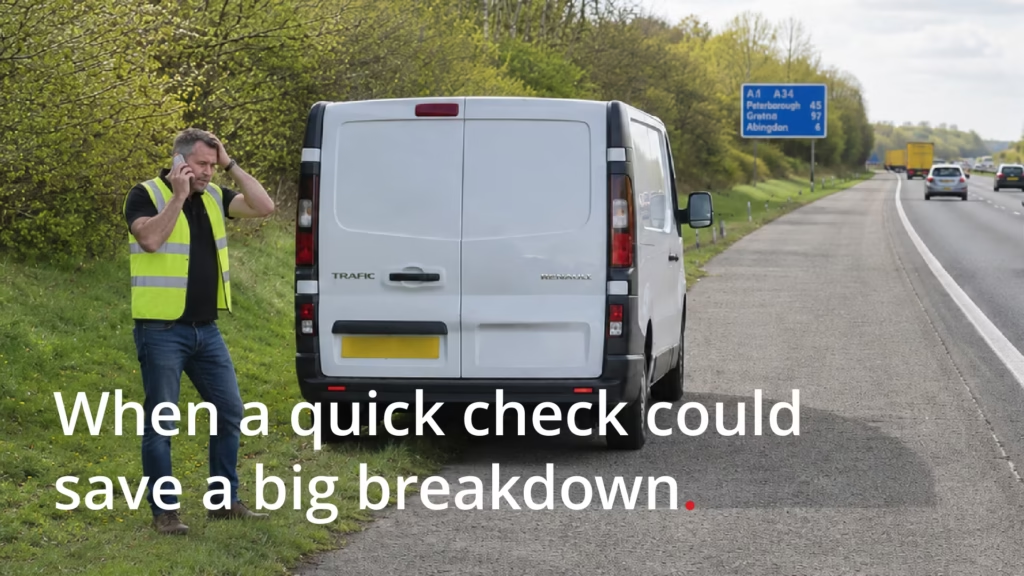
When checks are inconsistent, sod’s law as well as the cumulative nature of many mechanical problems mean that issues tend to surface at the worst possible time.
Any van can be stopped on the road for any number of reasons – and if someone spots a serious issue can lead to a prohibition notice by police or by the DVSA if it’s unroadworthy.
The driver is off the road, so until a replacement can be provided, jobs are delayed, customers are affected and the company absorbs operational disruption at least, and reputational impact at worst.
It’s not just about inconvenience, however, because drivers can also face enforcement action. This may include fines or penalty points – particularly if a defect should have been obvious during basic checks.
The driver is responsible at the point of use, and the fact that they don’t own the vehicle is irrelevant from a personal liability perspective.
They aren’t alone though – because the company owner / operator may also face action if the issue also points to a failure in maintenance or process, they oversee.
It’s a lose-lose scenario that should be avoided just as other compliance issues are avoided – a shared risk that causes everybody pain, cost and disruption.
If only… the value of early identification of vehicle issues
All this can be avoided if issues can be spotted before they cause problems. So many of the issues with vehicles are things that drivers could easily see with a regular check-over of their van. Most of them are things that drivers already know and would check as a matter of course for their own car…
- Tyres show wear over time, and they must meet legal tread depth requirements.
- Lights must be fully operational under road traffic regulations and replaced promptly.
- Oil leaks or low levels lead to friction and serious engine damage – they need fixing fast.
- Exterior damage and other serious safety issues are often apparent on inspection.
The challenge is not to turn your van drivers into mechanics, but it is about encouraging a simple, repeatable habit of checking the state of their van before the day begins – not just for legal compliance but to avoid hassle for them and disruption for the company.
How to help your drivers be responsible
If you want drivers to take responsibility for the vans you provide them, then you have to give clear and practical guidance. Most aren’t actively avoiding checks, they are just responding to what they see as the priorities of the job.
Giving clear and simple guidance will help such checks become seen as essential. Tell them what to look for and reinforce that this is to protect the driver as much as the business and its fleet of vehicles!
This is not about introducing heavy process and demands, but about encouraging behaviour that removes ambiguity and recognises their legal responsibility as driver of the vehicle.
What to send to your drivers
A quick text message reminder is often all you need to keep the need for daily van checks front of mind.
SMS / WhatsApp version:
Before you set off today, please do a quick van check: tyres, lights, mirrors, warning lights, leaks, load security, and doors.
If anything isn’t right, report it before you go. Thanks.
Taking 5 minutes to do this at the start of the day supports your legal responsibility as the driver and is far easier than dealing with a problem later.
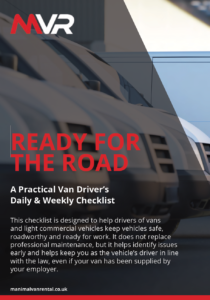
Download our Ready for the Road Driver Checklist here.
The final point
As a fleet manager, the issue is less about whether drivers check commercial vans exhaustively than whether they understand their responsibility for the vehicle. Any check is better than no check – but you can’t expect them to do this regularly or daily if you’ve never told them they should.
Sometimes, it’s about time – because building a checklist or instruction set is time consuming. That’s why we did it for you:
Download our Ready for the Road Driver Checklist here and send it to your team of drivers with our compliments!